·5/20/2026
from
Xingren Doufu
# Xingren Doufu
---
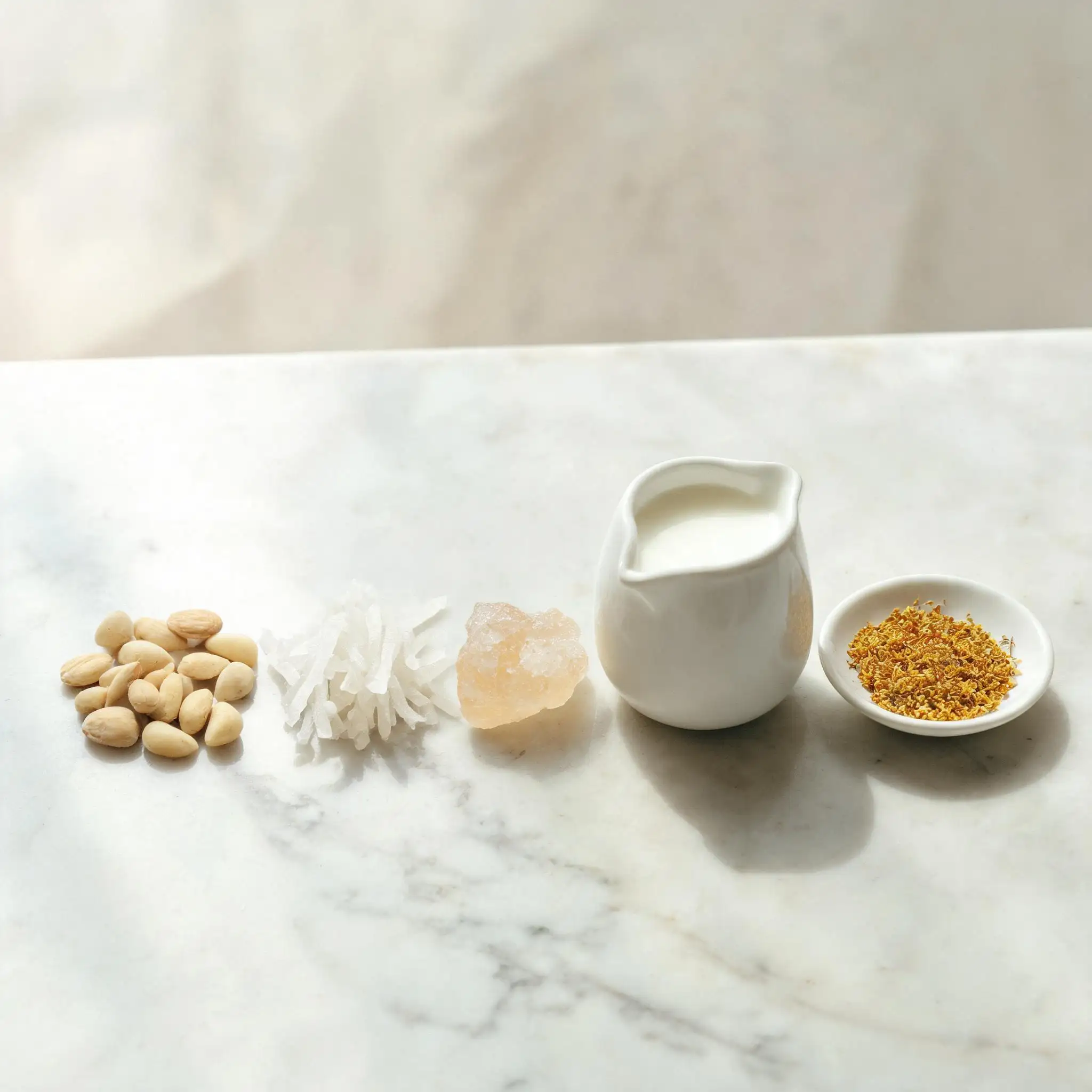
**Ingredients**
- Southern sweet almonds (南杏仁) — pale, flat, mild and faintly sweet; not the bitter northern variety
- Agar-agar strips — the setting agent; gives a firmer, cleaner set than gelatin
- Rock sugar (冰糖) — for the syrup; dissolves slowly and gives a clear, neutral sweetness
- Fresh whole milk — added to the almond liquid for body
- Osmanthus syrup (桂花糖浆) — amber, floral, made from preserved osmanthus flowers steeped in sugar syrup
- Wolfberries (枸杞) — a few, for color
---
Xingren doufu is not tofu. It contains no soybeans. It sets in a mold, it is cut into pieces, it is served in a bowl — and in these respects only it resembles tofu. The resemblance is one of shape and method. The material is entirely different.
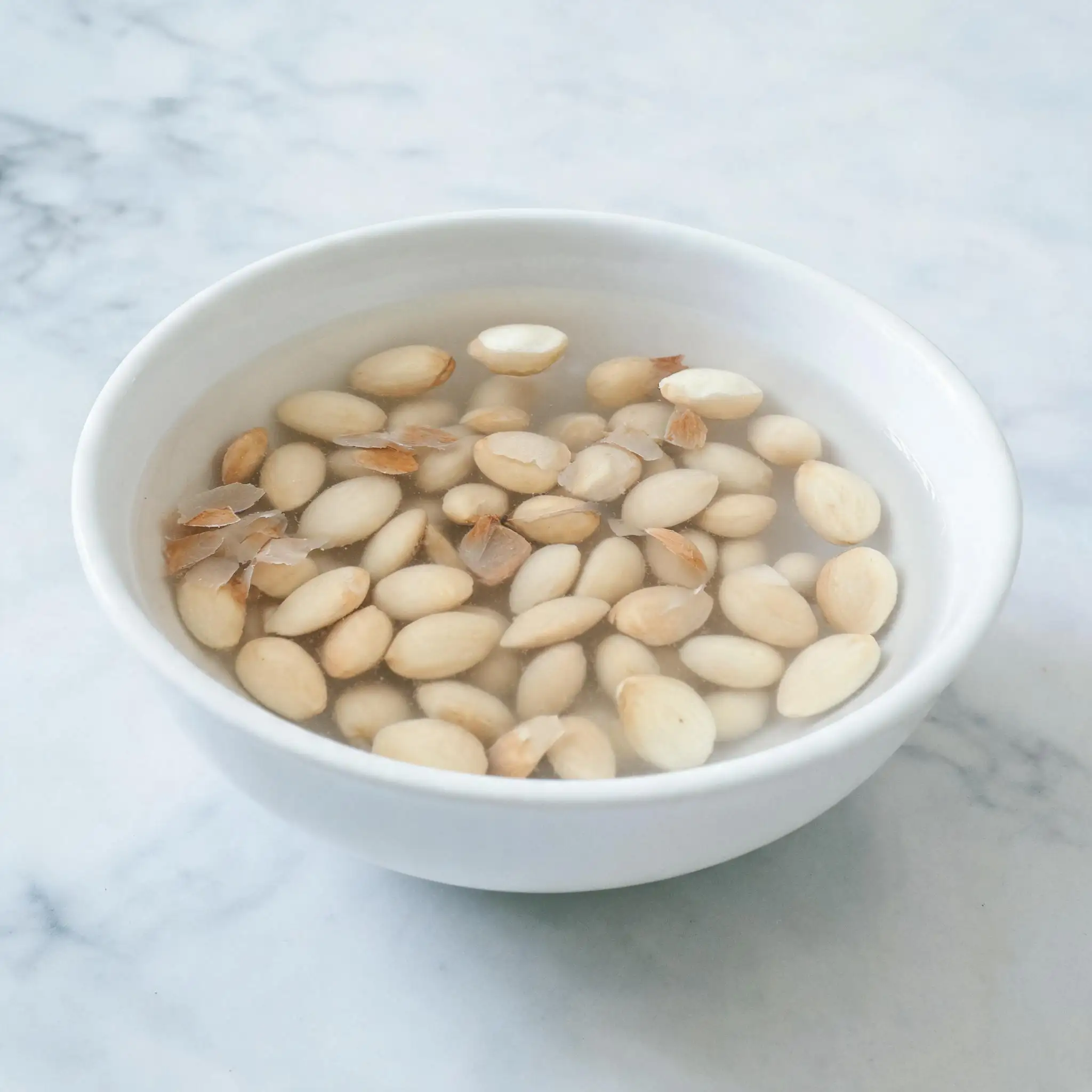
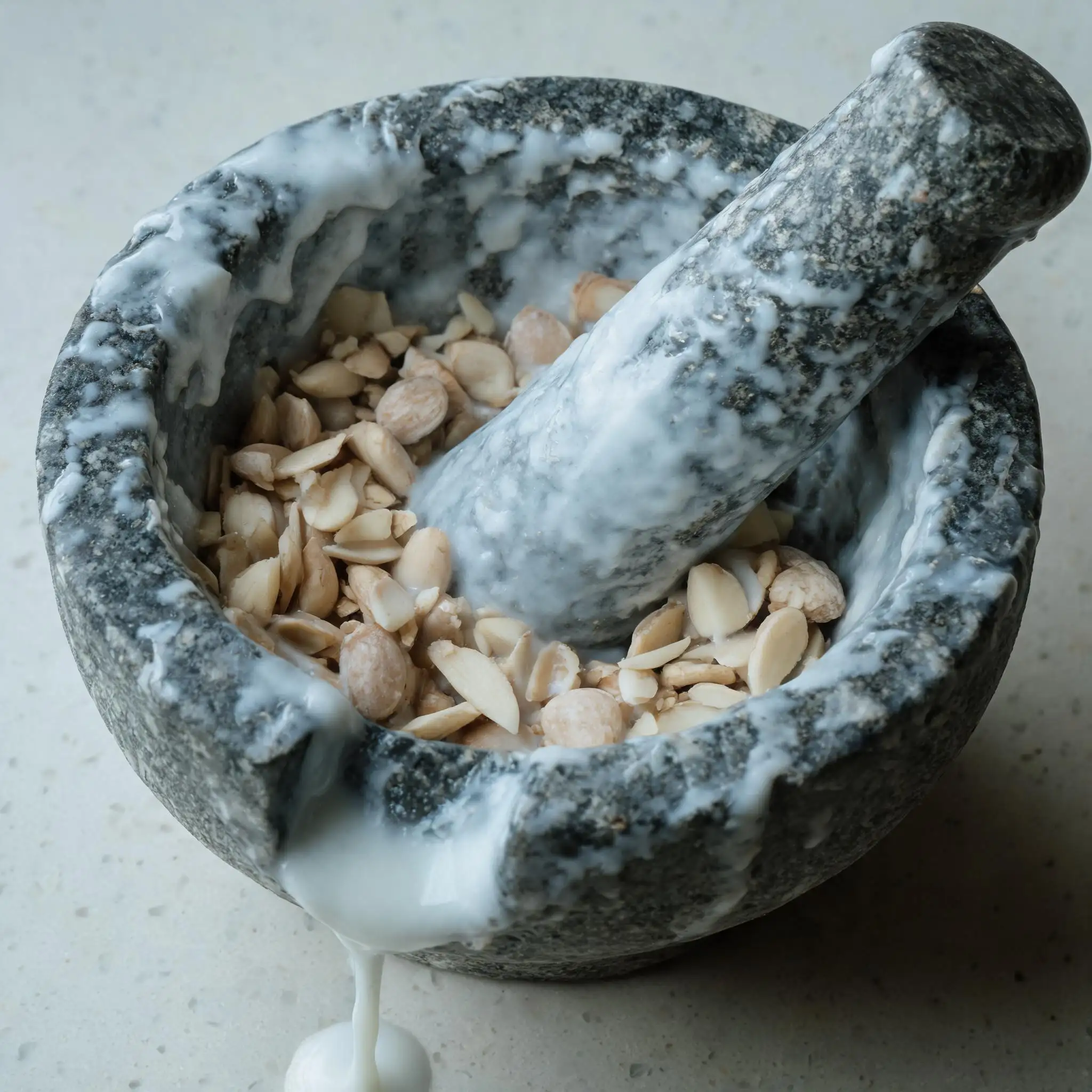
It begins with southern sweet almonds — 南杏仁, the mild variety, pale and flat, with a faint sweetness that raw northern almonds do not have. The almonds are soaked in cold water until they soften and their thin skins begin to loosen. Soaking takes several hours. The water turns faintly milky as the almonds release their oils and proteins into it. When the almonds are ready, they are ground — traditionally in a stone mortar with water, slowly, the stone working them down from whole kernels to broken pieces to a thick, white, opaque paste — then pressed through cloth to strain out the solids, leaving behind a liquid that is dense and white and smells of almonds.
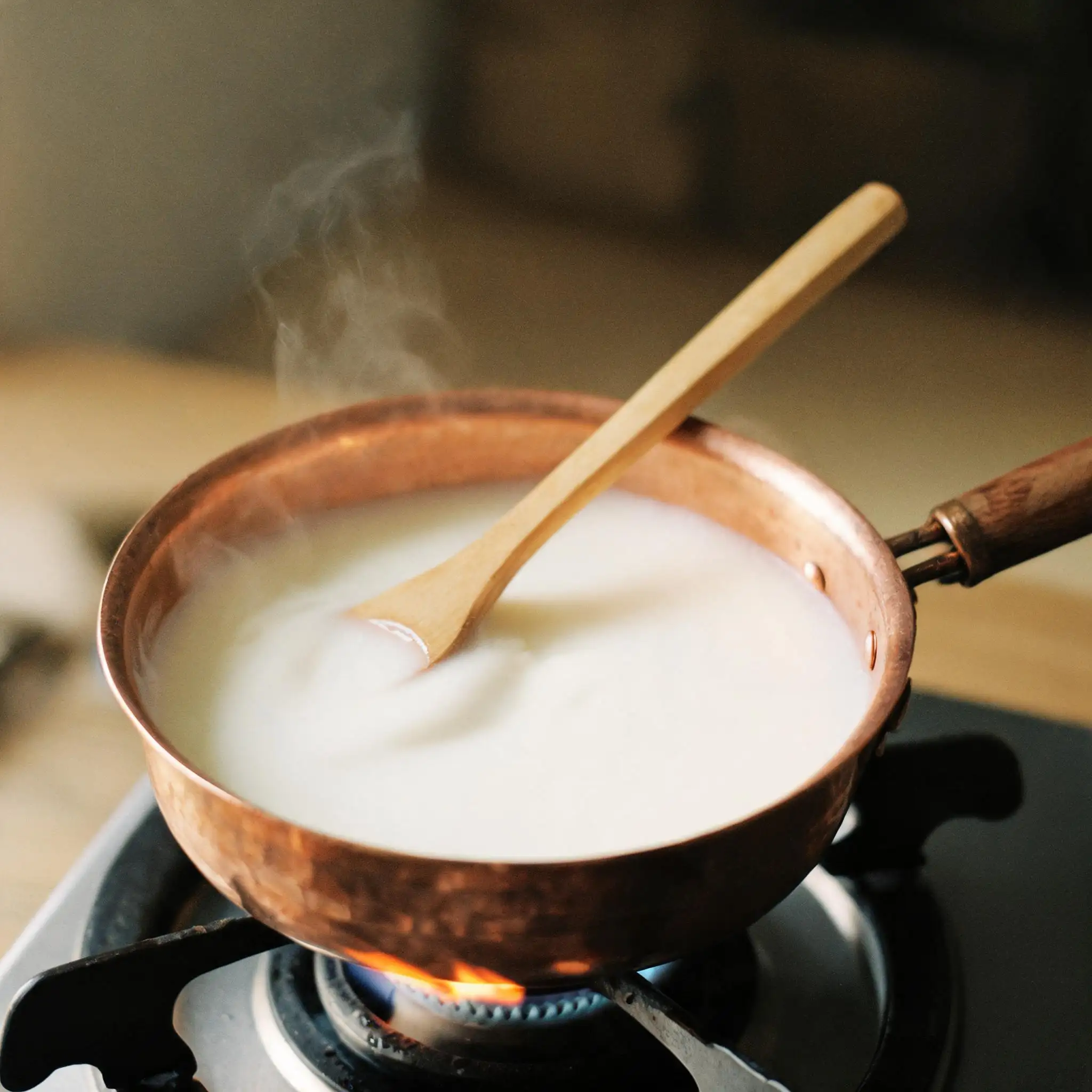
This liquid is combined with whole milk, which adds fat and body. Agar-agar — dried strips of seaweed-derived setting agent — has been dissolved separately in hot water and added to the almond-milk mixture in the pot. The mixture is heated gently, stirred with a wooden paddle, brought just to the edge of a simmer. No boiling. The agar dissolves completely, invisible in the white liquid. Rock sugar goes in. The mixture is tasted and adjusted.
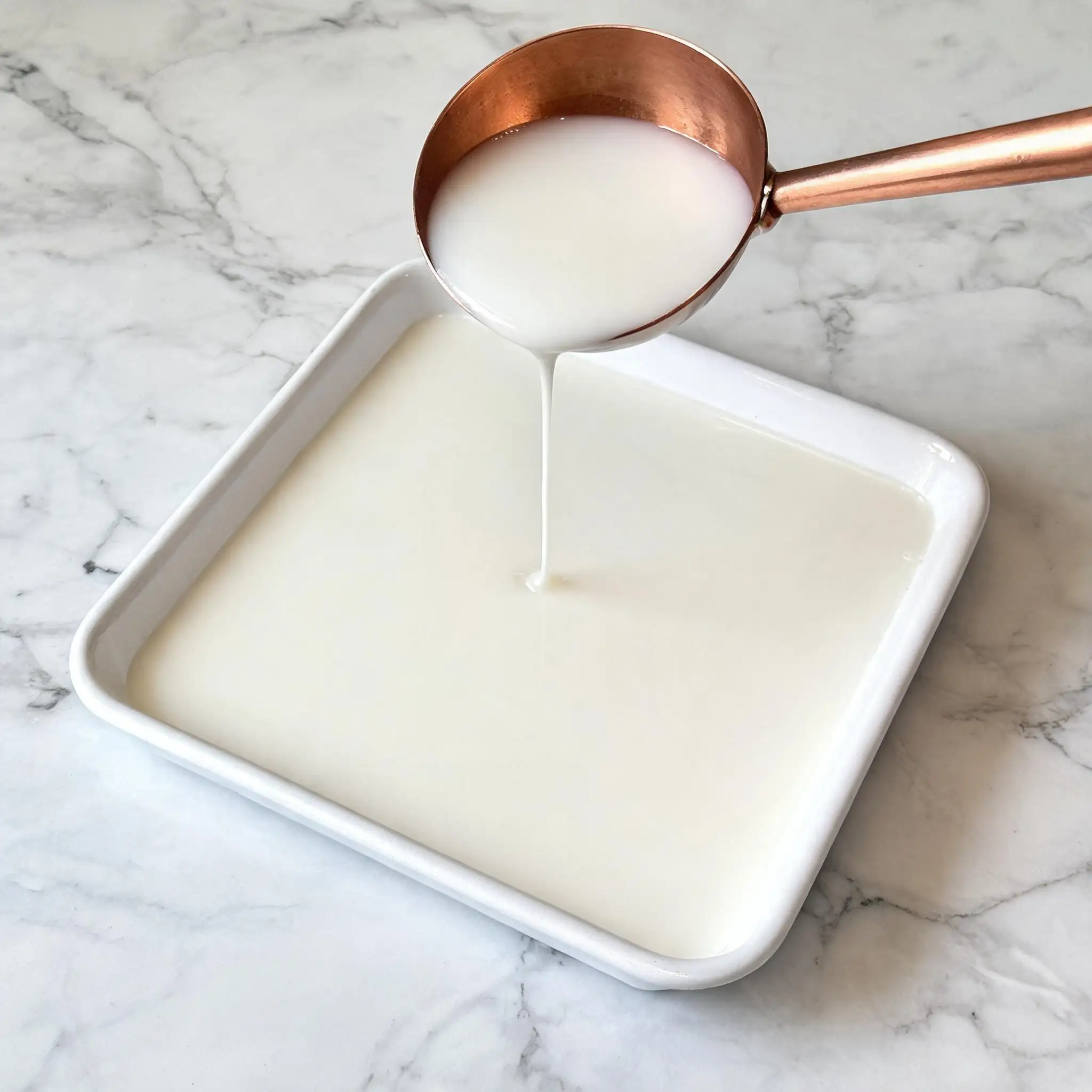
Then it is poured into molds — shallow, flat, square trays — and left to cool at room temperature before being moved to a cold place to set completely. The surface of the liquid in the tray is perfectly smooth when it goes in, reflecting the light like a white mirror. Over an hour or two it changes from liquid to solid without any visible sign of the transition: no bubbling, no shrinkage, no color change. It simply becomes firm.
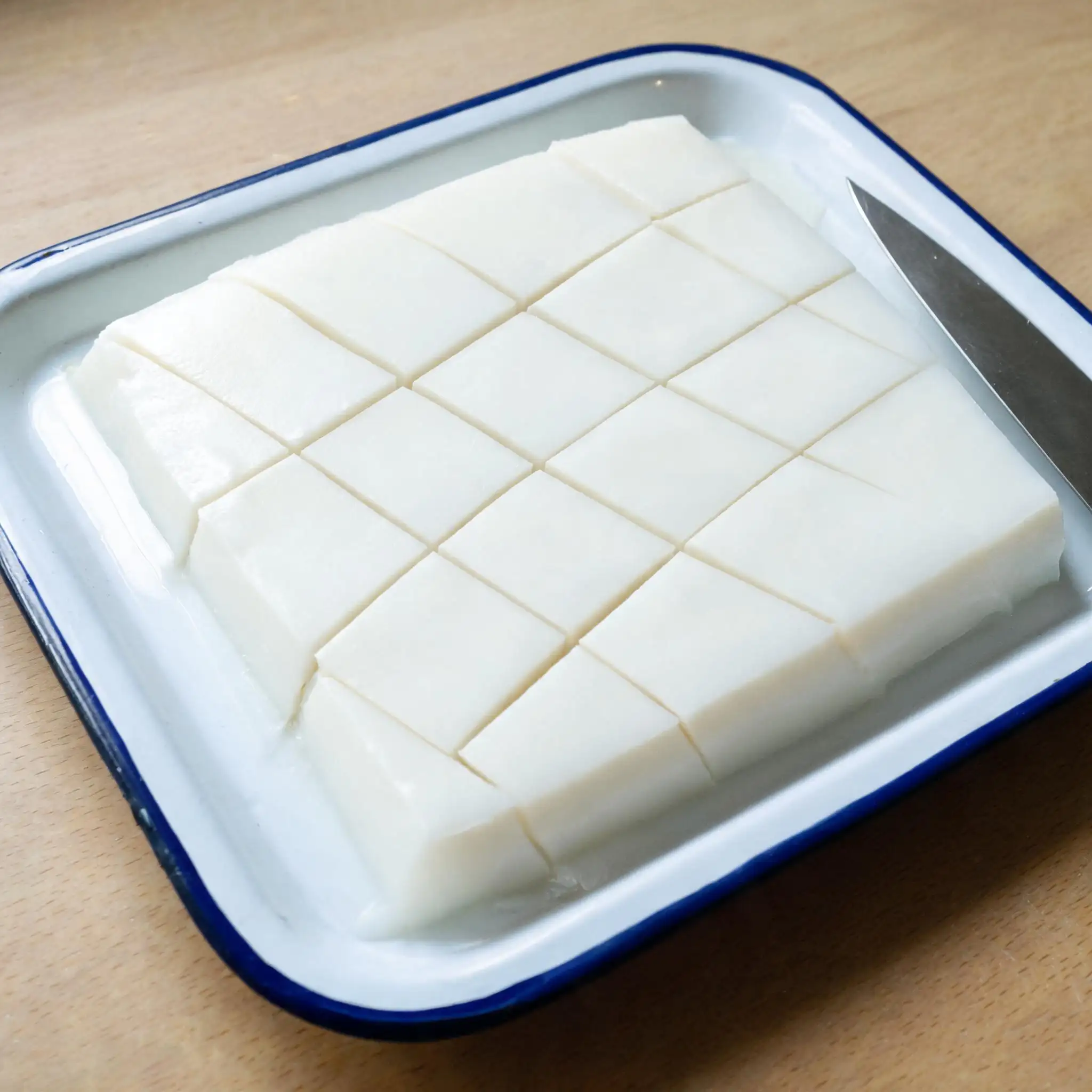
When it has set, it is a white slab, uniform in color and texture, smooth on top, firm enough to hold its shape when cut. A thin, sharp knife makes parallel diagonal cuts across the surface, then perpendicular cuts, producing diamond shapes. The cut edges are clean and precise. The jelly is cool to the touch and holds its form without crumbling at the edges.
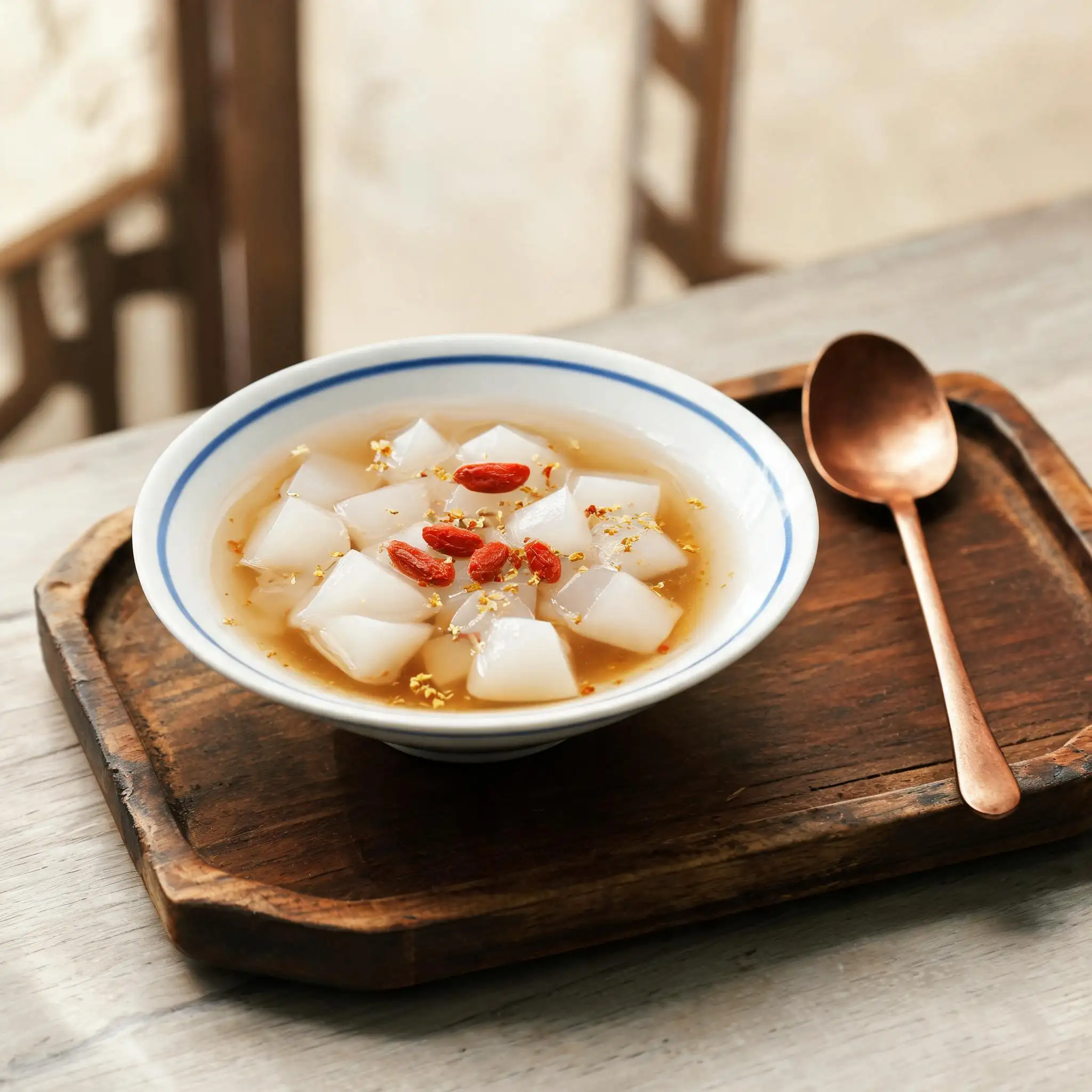
The pieces are transferred to a bowl — wide, shallow, ceramic — and cold, lightly sweetened sugar syrup is ladled over them. The syrup is nearly clear: just sugar dissolved in water, cooled completely. The pieces of almond jelly float in it, white against transparent, their surfaces slightly reflective. In the bowl they look like pieces of fresh snow that have not yet melted.
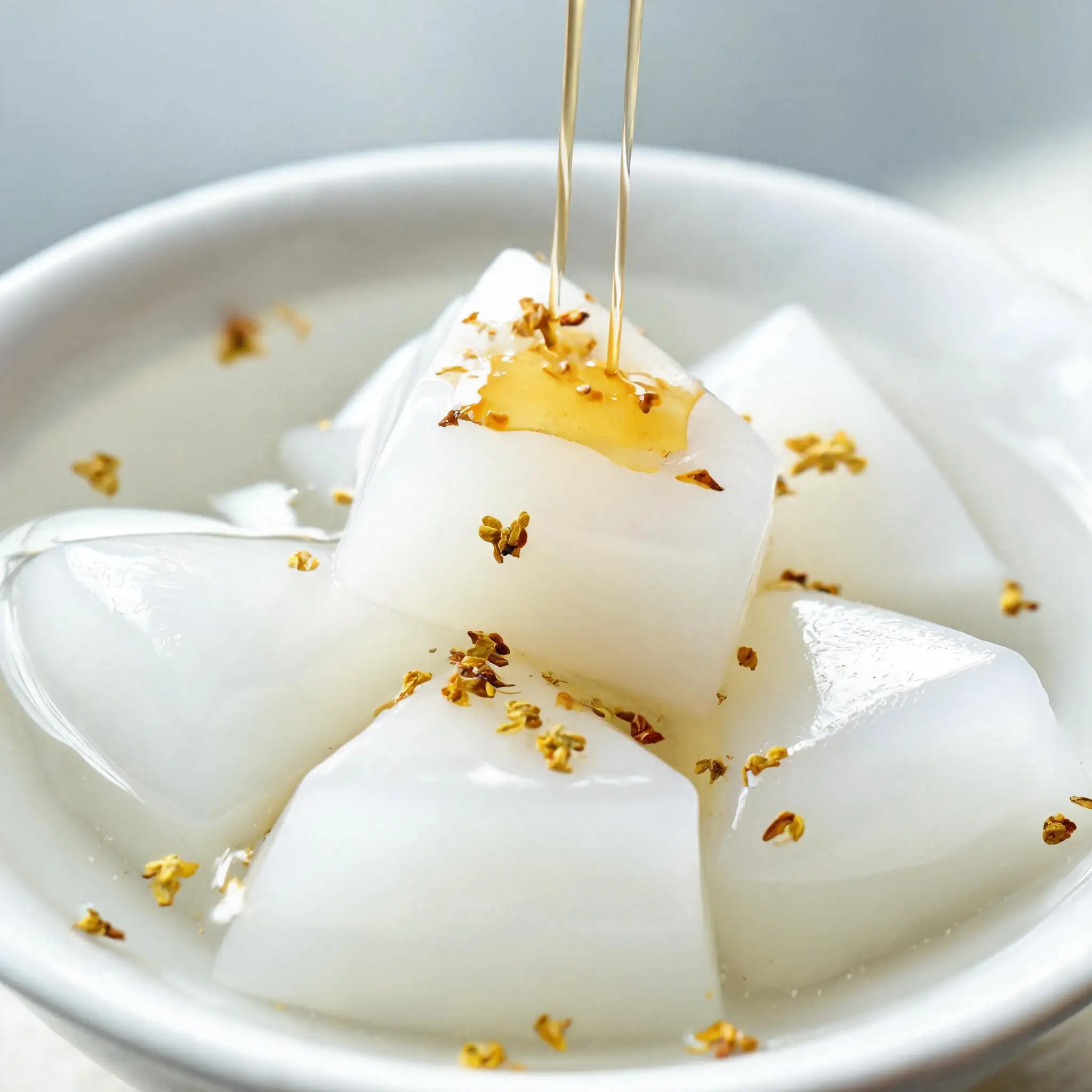
Osmanthus syrup goes on last. It is amber — a deep golden-yellow, thick and fragrant, made from preserved osmanthus flowers that have steeped in sugar for months. A thin drizzle from a spoon, starting at the center piece and moving outward: the amber liquid lands on the white surface, spreads in a slow pool, tints the clear syrup beneath it slightly gold. A few wolfberries, red, are placed on top. A few dried osmanthus flowers scatter across the surface — gold-yellow, tiny, each one distinct.
The flavor of xingren doufu is cool and mild. The almond flavor is present but restrained — not the sharp bitterness of the northern variety, not the intensity of roasted almonds, something quieter: a background note of nut and sweetness. The texture is the main event. Agar-agar sets differently from gelatin: firmer, less yielding, with a faint resistance before it gives way, a clean break rather than a slow collapse. It does not melt in the mouth the way gelatin does. It holds its form longer, then releases all at once.
The osmanthus syrup introduces a floral note — sweet, slightly spiced, the specific perfume of osmanthus that has no close equivalent in other cuisines. Against the clean white of the jelly and the neutral sweetness of the syrup, it is the only assertive flavor in the bowl.
Xingren doufu is a summer dessert, though it appears in Beijing teahouses and old-style restaurants year-round. It is served cold. It is eaten with a spoon. It is quiet food — not demanding, not demonstrating anything. The work that went into making it — the soaking, the grinding, the straining, the careful heating — is invisible in the finished bowl. What you see is a white piece of jelly in clear syrup with a drizzle of amber and a few red berries.
That is the point.
---
**Ingredients**
- Southern sweet almonds (南杏仁) — pale, flat, mild and faintly sweet; not the bitter northern variety
- Agar-agar strips — the setting agent; gives a firmer, cleaner set than gelatin
- Rock sugar (冰糖) — for the syrup; dissolves slowly and gives a clear, neutral sweetness
- Fresh whole milk — added to the almond liquid for body
- Osmanthus syrup (桂花糖浆) — amber, floral, made from preserved osmanthus flowers steeped in sugar syrup
- Wolfberries (枸杞) — a few, for color
---
Xingren doufu is not tofu. It contains no soybeans. It sets in a mold, it is cut into pieces, it is served in a bowl — and in these respects only it resembles tofu. The resemblance is one of shape and method. The material is entirely different.
It begins with southern sweet almonds — 南杏仁, the mild variety, pale and flat, with a faint sweetness that raw northern almonds do not have. The almonds are soaked in cold water until they soften and their thin skins begin to loosen. Soaking takes several hours. The water turns faintly milky as the almonds release their oils and proteins into it. When the almonds are ready, they are ground — traditionally in a stone mortar with water, slowly, the stone working them down from whole kernels to broken pieces to a thick, white, opaque paste — then pressed through cloth to strain out the solids, leaving behind a liquid that is dense and white and smells of almonds.
This liquid is combined with whole milk, which adds fat and body. Agar-agar — dried strips of seaweed-derived setting agent — has been dissolved separately in hot water and added to the almond-milk mixture in the pot. The mixture is heated gently, stirred with a wooden paddle, brought just to the edge of a simmer. No boiling. The agar dissolves completely, invisible in the white liquid. Rock sugar goes in. The mixture is tasted and adjusted.
Then it is poured into molds — shallow, flat, square trays — and left to cool at room temperature before being moved to a cold place to set completely. The surface of the liquid in the tray is perfectly smooth when it goes in, reflecting the light like a white mirror. Over an hour or two it changes from liquid to solid without any visible sign of the transition: no bubbling, no shrinkage, no color change. It simply becomes firm.
When it has set, it is a white slab, uniform in color and texture, smooth on top, firm enough to hold its shape when cut. A thin, sharp knife makes parallel diagonal cuts across the surface, then perpendicular cuts, producing diamond shapes. The cut edges are clean and precise. The jelly is cool to the touch and holds its form without crumbling at the edges.
The pieces are transferred to a bowl — wide, shallow, ceramic — and cold, lightly sweetened sugar syrup is ladled over them. The syrup is nearly clear: just sugar dissolved in water, cooled completely. The pieces of almond jelly float in it, white against transparent, their surfaces slightly reflective. In the bowl they look like pieces of fresh snow that have not yet melted.
Osmanthus syrup goes on last. It is amber — a deep golden-yellow, thick and fragrant, made from preserved osmanthus flowers that have steeped in sugar for months. A thin drizzle from a spoon, starting at the center piece and moving outward: the amber liquid lands on the white surface, spreads in a slow pool, tints the clear syrup beneath it slightly gold. A few wolfberries, red, are placed on top. A few dried osmanthus flowers scatter across the surface — gold-yellow, tiny, each one distinct.
The flavor of xingren doufu is cool and mild. The almond flavor is present but restrained — not the sharp bitterness of the northern variety, not the intensity of roasted almonds, something quieter: a background note of nut and sweetness. The texture is the main event. Agar-agar sets differently from gelatin: firmer, less yielding, with a faint resistance before it gives way, a clean break rather than a slow collapse. It does not melt in the mouth the way gelatin does. It holds its form longer, then releases all at once.
The osmanthus syrup introduces a floral note — sweet, slightly spiced, the specific perfume of osmanthus that has no close equivalent in other cuisines. Against the clean white of the jelly and the neutral sweetness of the syrup, it is the only assertive flavor in the bowl.
Xingren doufu is a summer dessert, though it appears in Beijing teahouses and old-style restaurants year-round. It is served cold. It is eaten with a spoon. It is quiet food — not demanding, not demonstrating anything. The work that went into making it — the soaking, the grinding, the straining, the careful heating — is invisible in the finished bowl. What you see is a white piece of jelly in clear syrup with a drizzle of amber and a few red berries.
That is the point.