·5/12/2026
from
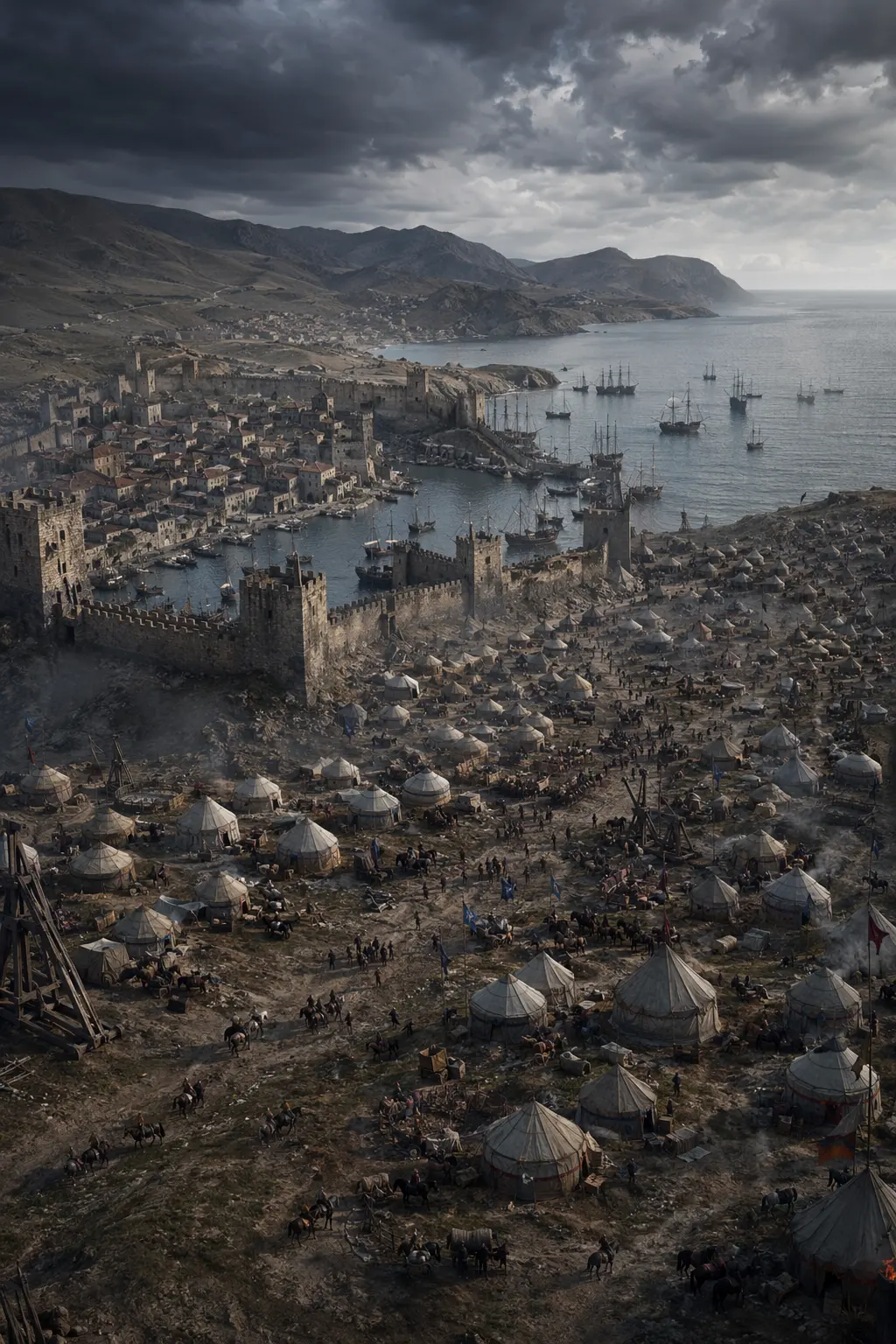
The Black Death began with biological warfare. A Mongol khan catapulted plague corpses into Caffa.
In October 1347, twelve Genoese trading galleys docked at the port of Messina, Sicily. Most of the sailors aboard were dead. The ones still alive were covered in black swellings that oozed blood and pus.
The harbor master ordered the ships out of port immediately. He refused them entry. He was doing exactly the right thing.
He was six weeks too late.
---
**The story actually begins a year earlier, in 1346, at a city called Caffa.**
Caffa was a Genoese trading colony on the Black Sea coast — modern Feodosia, in Crimea. One of the most important commercial hubs connecting Europe to the Silk Road. It had been under siege by the Mongol Golden Horde for two years.
Then plague broke out inside the Mongol camp.
Khan Janibeg was losing soldiers to disease faster than to the defenders on the walls. In what is one of the earliest documented acts of deliberate biological warfare in recorded history, he made a decision: load the catapults with the bodies of his own plague-dead, and throw them over the walls into the city.
The primary source for this is **Gabrielle de' Mussis**, a Genoese notary who interviewed survivors. His account, *Historia de Morbo* (c. 1348), is direct: *"mountains of dead"* were hurled into Caffa. The defenders tried to throw the bodies into the sea as fast as possible. They couldn't keep up.
---
**What happened next is the actual mechanism of the Black Death's arrival in Europe.**
The Genoese merchants who survived the siege fled by ship. They didn't go straight to Sicily. They stopped first at **Constantinople** — the Byzantine capital, the largest city in the Mediterranean world — where the plague tore through a population of perhaps 400,000. The Emperor John VI Kantakouzenos lost his own son. He wrote an eyewitness account describing the speed of death: sometimes hours between first symptoms and the end.
Constantinople lost perhaps a third of its population.
The ships continued west.
---
**Port after port tried to stop them.**
Messina expelled the galleys in October 1347. Marseille followed in November. Genoa — so desperate they fired burning arrows at their own city's merchant vessels to keep them out. Venice anchored suspect ships offshore and eventually formalized this into law: forty days of isolation before anyone could come ashore.
*Quarantino.* Forty days. That's where the word **quarantine** comes from.
Every one of these harbor masters was doing the correct thing. The problem was that *Yersinia pestis* doesn't travel on sick sailors. It travels on fleas that travel on rats. The rats came ashore the moment a ship tied up at a dock. By the time you expelled the visible sick, the invisible passenger had already left the ship.
No one in 1347 was watching the rats. No one knew to watch the rats.
---
**By 1350, Europe had lost between a third and half its entire population.**
Florence lost perhaps 60% of its people in a single year. Paris buried 800 dead per day at the peak. England — reached through the port of Weymouth in the summer of 1348 — lost between 30 and 45% of its population.
The chain of causation runs in a straight line: a Mongol general's decision at a Black Sea siege → twelve ships → a harbor master's correct but too-late order → a continent that would never be the same.
---
The part of this story I find most striking isn't the scale of the death. It's that the people trying to stop it were *right.* The harbor masters understood contagion. Venice invented quarantine. The instinct to isolate and contain was there in 1347.
They just didn't know about the fleas.
---
Happy to go deeper on any part of this — the 2022 genomic study from Kyrgyzstan that may have finally located the geographic origin of the outbreak, the Byzantine eyewitness accounts, or what the Black Death did to the authority of the Church in the years that followed.
Sources in the first comment.
---
---
---
The harbor master ordered the ships out of port immediately. He refused them entry. He was doing exactly the right thing.
He was six weeks too late.
---
**The story actually begins a year earlier, in 1346, at a city called Caffa.**
Caffa was a Genoese trading colony on the Black Sea coast — modern Feodosia, in Crimea. One of the most important commercial hubs connecting Europe to the Silk Road. It had been under siege by the Mongol Golden Horde for two years.
Then plague broke out inside the Mongol camp.
Khan Janibeg was losing soldiers to disease faster than to the defenders on the walls. In what is one of the earliest documented acts of deliberate biological warfare in recorded history, he made a decision: load the catapults with the bodies of his own plague-dead, and throw them over the walls into the city.
The primary source for this is **Gabrielle de' Mussis**, a Genoese notary who interviewed survivors. His account, *Historia de Morbo* (c. 1348), is direct: *"mountains of dead"* were hurled into Caffa. The defenders tried to throw the bodies into the sea as fast as possible. They couldn't keep up.
---
**What happened next is the actual mechanism of the Black Death's arrival in Europe.**
The Genoese merchants who survived the siege fled by ship. They didn't go straight to Sicily. They stopped first at **Constantinople** — the Byzantine capital, the largest city in the Mediterranean world — where the plague tore through a population of perhaps 400,000. The Emperor John VI Kantakouzenos lost his own son. He wrote an eyewitness account describing the speed of death: sometimes hours between first symptoms and the end.
Constantinople lost perhaps a third of its population.
The ships continued west.
---
**Port after port tried to stop them.**
Messina expelled the galleys in October 1347. Marseille followed in November. Genoa — so desperate they fired burning arrows at their own city's merchant vessels to keep them out. Venice anchored suspect ships offshore and eventually formalized this into law: forty days of isolation before anyone could come ashore.
*Quarantino.* Forty days. That's where the word **quarantine** comes from.
Every one of these harbor masters was doing the correct thing. The problem was that *Yersinia pestis* doesn't travel on sick sailors. It travels on fleas that travel on rats. The rats came ashore the moment a ship tied up at a dock. By the time you expelled the visible sick, the invisible passenger had already left the ship.
No one in 1347 was watching the rats. No one knew to watch the rats.
---
**By 1350, Europe had lost between a third and half its entire population.**
Florence lost perhaps 60% of its people in a single year. Paris buried 800 dead per day at the peak. England — reached through the port of Weymouth in the summer of 1348 — lost between 30 and 45% of its population.
The chain of causation runs in a straight line: a Mongol general's decision at a Black Sea siege → twelve ships → a harbor master's correct but too-late order → a continent that would never be the same.
---
The part of this story I find most striking isn't the scale of the death. It's that the people trying to stop it were *right.* The harbor masters understood contagion. Venice invented quarantine. The instinct to isolate and contain was there in 1347.
They just didn't know about the fleas.
---
Happy to go deeper on any part of this — the 2022 genomic study from Kyrgyzstan that may have finally located the geographic origin of the outbreak, the Byzantine eyewitness accounts, or what the Black Death did to the authority of the Church in the years that followed.
Sources in the first comment.
---
---
---